What Life Is Really Like in France - Part 1
At least in my little corner of Alsace
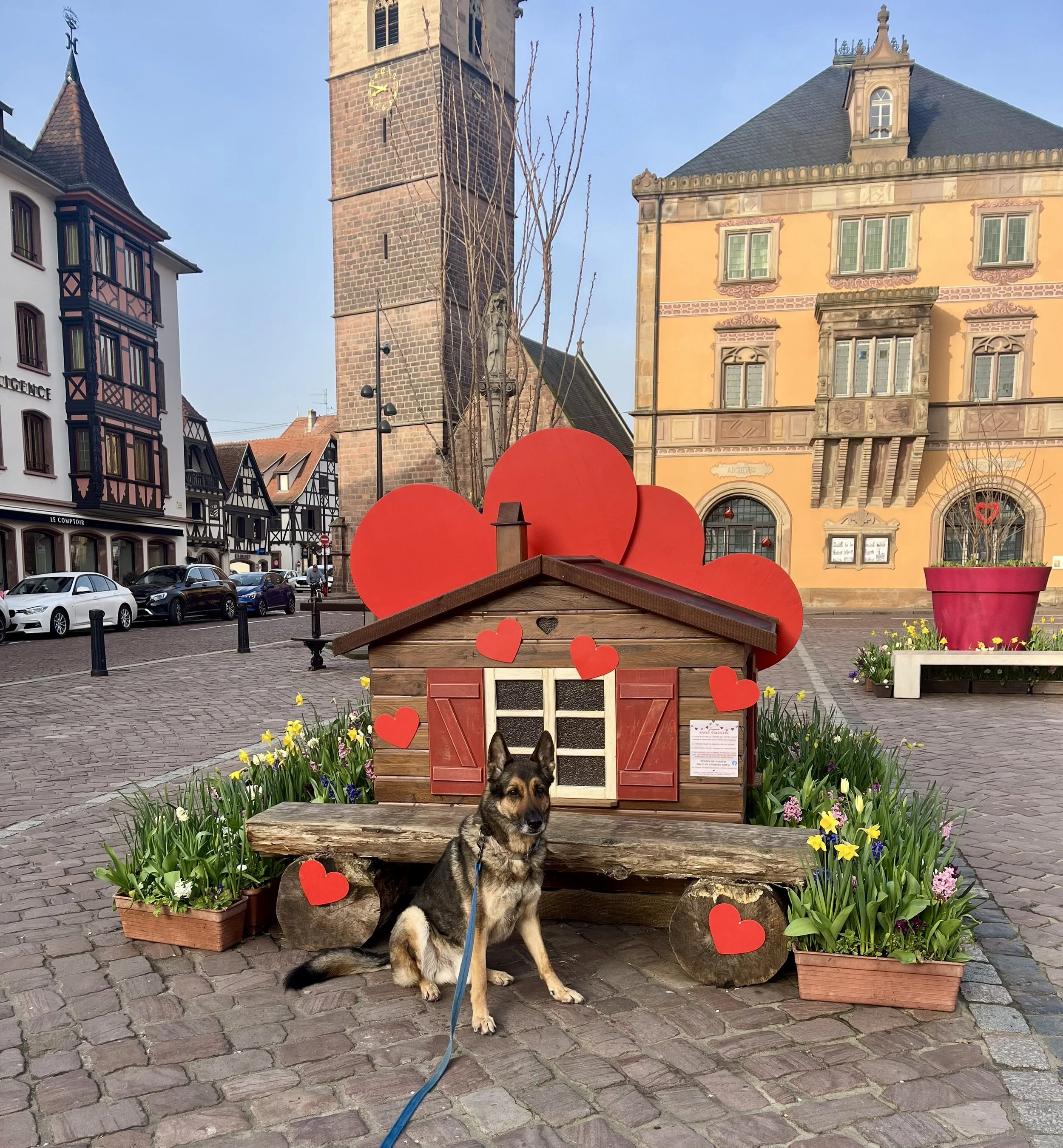
My Valentine.
I had my immigration appointment last month.
At 8:15 a.m. on a Monday, a small group of us huddled on the stairs of the OFII (l’Office Français de l’Immigration et de l’Intégration) office in Strasbourg, waiting to be summoned one-by-one through security and taken to a small classroom. The classroom did its best to be cheerful in a bureaucratic setting: textured plaster walls painted a warm yellow, a portrait of a smiling President Macron, colorful posters orienting visitors to various aspects of immigration and integration into France.
The rows of chairs — equipped with those little fold-down desks half the size of an airplane tray — were spaced out like it was test day at school. Everyone selected their own seat, and then waited patiently for the next steps.
After a brief orientation given in French, we were each given a written French language assessment and oral language assessment, followed by a doctor’s visit and a consultation with an OFII agent. The visit ended with me signing an integration contract and showing I had completed each of the four required steps for today.
Overall, the experience went smoothly and operated with unexpected efficiency. Additionally, the OFII staff were kind, friendly, supportive, and encouraging — something I also wasn’t expecting from any type of bureaucracy.
I left my completed appointment an hour ahead of schedule, equipped with a folder containing important paperwork to keep for the rest of my life (seriously — the agent instructed me to keep it pour la vie, and to only ever submit photocopies should some government entity need it), appointments for four civics classes spread across the next two months, and a language assessment of B1 intermediate level in written French and A2 level in spoken French.
Not to shabby for starting to learn French 660 days ago (according to my Duolingo), with only one year of actual French classes under my belt.
For those who are interested, in addition to Duolingo, I also used Alliance Française Sacramento to take official courses, as well as ATFrenchies (which I still use, because it’s a great online learning community and the instructors are fantastic!). I also take a language course twice a week through my local community center (a great way to make new friends!).
As I sat on the train staring at my OFII folder in front of me, I felt an internal shift. This made things much more real. Like, I wasn’t just a tourist here on an extended vacation. I’m a French resident now.
Which begs the question that everyone is dying to know: What’s it really like living in France?
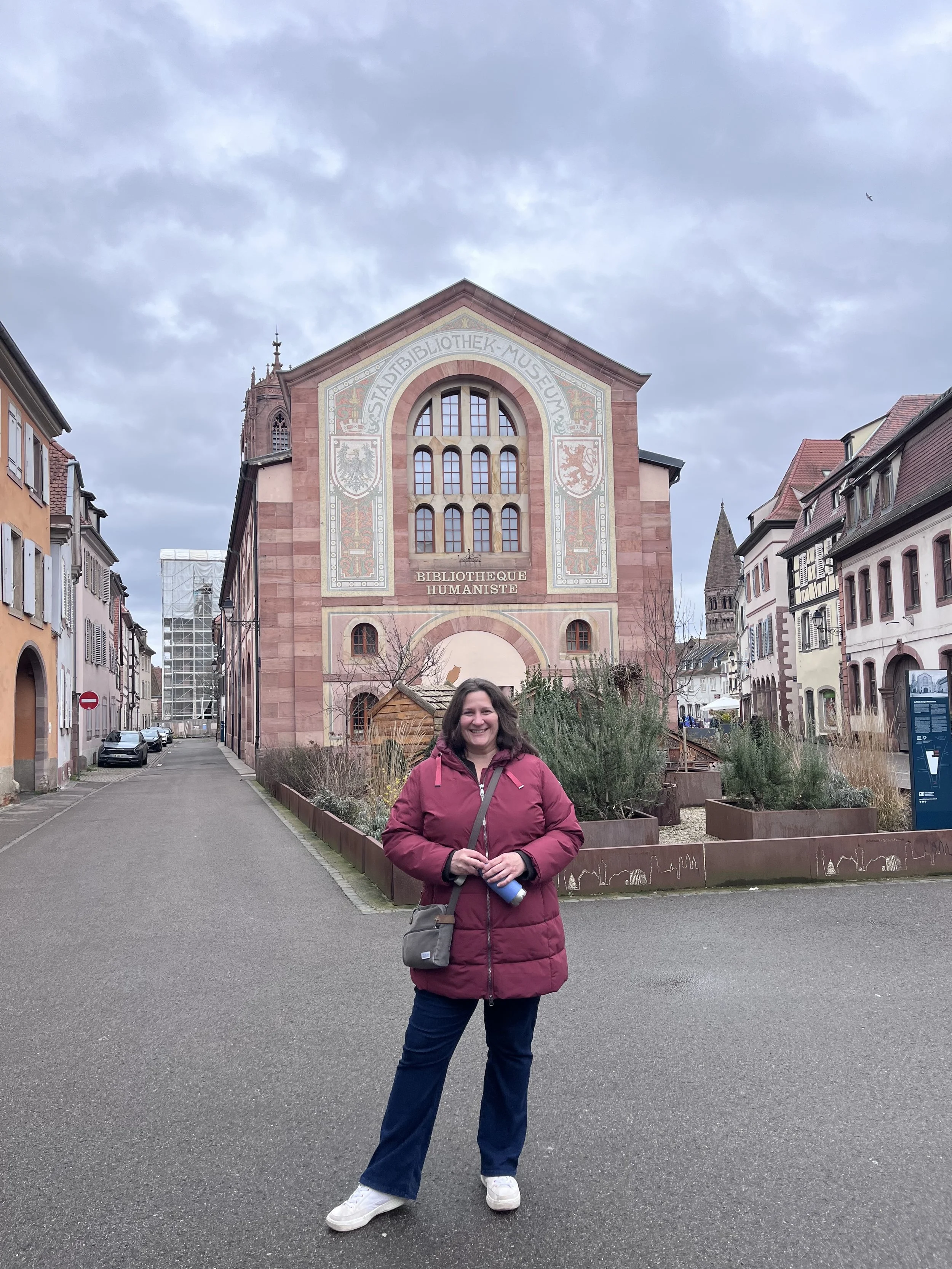
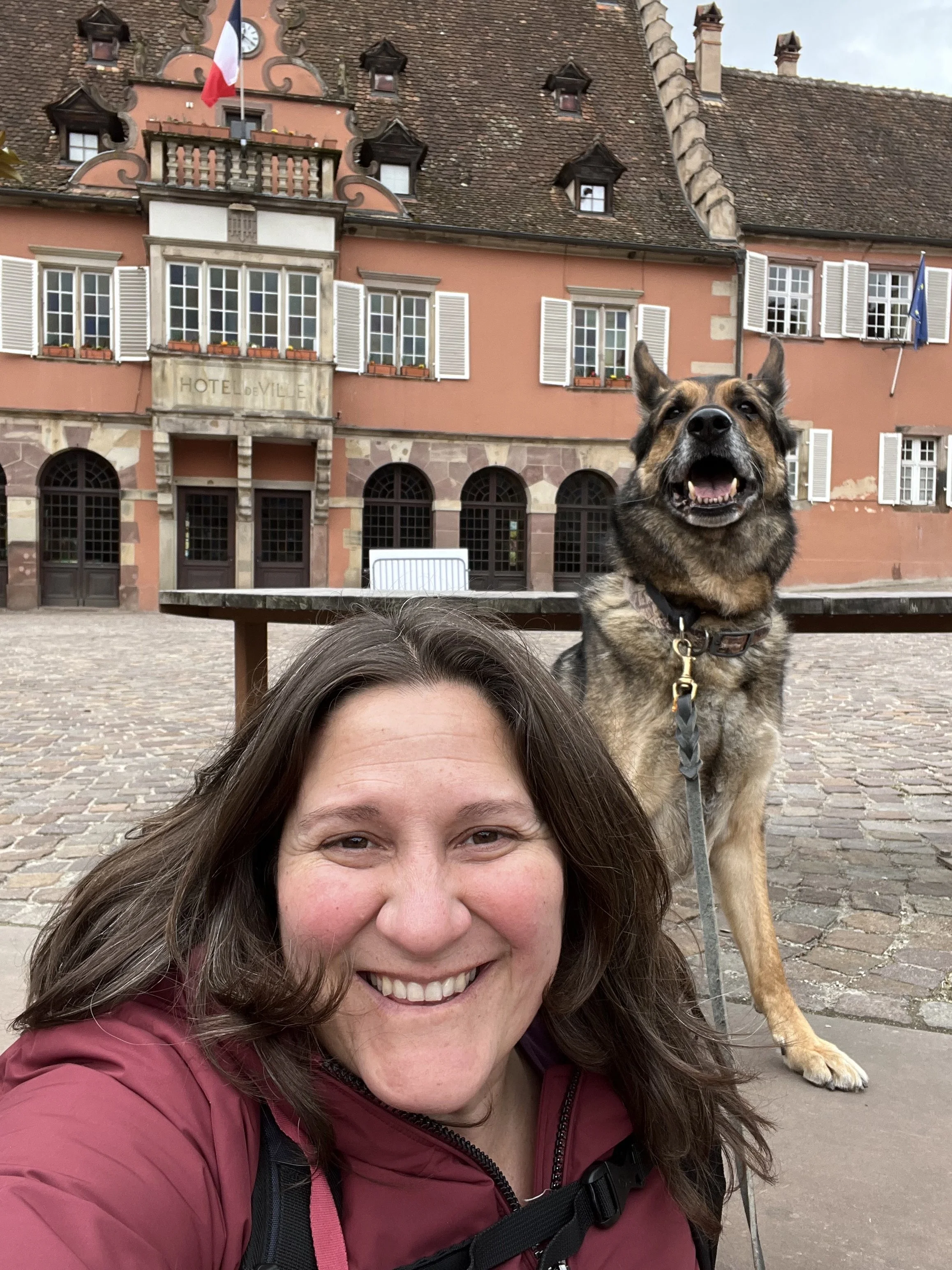
My Little Corner of France
France is more than just Paris. It is a diverse country with distinct differences among its regions (13 continental regions, and 5 overseas regions from France’s imperialist and colonial past) and 101 departments (96 within France’s continental borders, and 5 overseas). Each region has its own culture, heritage, traditions, cuisine, and specialized AOP products such as cheese, wine, spirits, nuts, and produce. They also have their own distinct vibe, and some even have their own language (such as Alsatian in Alsace, and Breton in Brittany).
For example, here in Alsace there is a strong Germanic influence on the architecture, culture, and food. From the half-timbered houses found throughout the region and the Haussmannian Neustadt quarter in Strasbourg, to the many Germanic names of the towns, to the more guttural tone of the Alsatian language, to regional specialties involving sauerkraut, sausages, ham, lots of cheese and bread, pretzels (called bretzels here), Alsace’s history of being part of both Germany and France over the centuries is clearly evident.
It is in this narrow 170-km stretch of eastern France, bordered by both Germany and Switzerland, that I’ve found my place to carve out my new life. I love it here. The architecture, the vineyards, the green spaces and parks, nature at my doorstep, the storks (who have returned for the spring!), the herons, the people, the wine, the food, the language, the slower pace of life — I love it all so much.
Not that it isn’t without its quirks, frustrations, or drawbacks; no place is perfect.
In fact, there’s been many adjustments and things I’ve learned over the past six months — too much to include in one blog. In today’s Part 1 installment, I share my observations about the people, the food, the transportation, and overall daily life.
The People
People are polite, but having a conversation past ‘Bonjour’ takes time.
There’s an assumption that the French are rude. That has not been my experience here in Alsace, although I have been told by my French friends who live here that Alsace is one of the friendlier places in France. People here are very polite, calm, and self-contained. Everyone says ‘Bonjour’ when you pass each other on the street or enter a shop, and each interaction is rooted in polite distance.
French people don’t make small talk either (although being in a touristy area, I think people are more adept at it here). It took about two months before the neighbors I passed every day went from saying ‘Bonjour’ to offering small waves from afar with their ‘Bonjour’, and about three months before they actually stopped to have conversations in French.
The first time a casual conversation happened out in the wild, it felt like the biggest win, an tiny acknowledgment that I was becoming part of the community and not just a tourist.
Even at events, people start off polite and a little distant, but as your participation continues and the wine starts flowing, everyone loosens up a little. The next thing you know, you’re suddenly being asked about your opinion on the wine, the music, or your favorite French artist.
People are curious.
They want to know what brought me here. Why Alsace? Why this town of only 12,000 people?Do you like it here?What do you like about it? While I stumbled through my answers at first, I’ve become more confident and adept at explaining this all in French (because yes, you need to definitely learn French to live in France).
People inevitably want to know where I’m from once they hear my accent. I always lead with “Je viens de Californie” (“I come from California”) for two reasons: 1) the current regime of the U.S. is deeply unpopular in much of Europe (and the world) and thus I hesitate to lead with “I’m from the U.S.”, and 2) French understanding of U.S. geography is limited — we have a lot of states and many of them remain relatively unknown here — but they do know and love California (and I also did live in California).
People are kind.
Like, genuinely kind, even if they don’t know you. There is a sense of collective care, without it being invasive. The French won’t ask for your whole life story right away like people do in the U.S.. They may not share much about themselves, either — including their name (that’s given when a certain level of acceptance is reached). But people here have shown me so much kindness, whether it was writing a check for Hadyn’s ICAD registration even though I had just met them, giving me a ride to the vet or back into town, being patient with me and helping me with my French, or even providing support and recommendations for my business. So far, people have been kind and considerate when it counts for something, rather than “being nice” just to “be nice.”
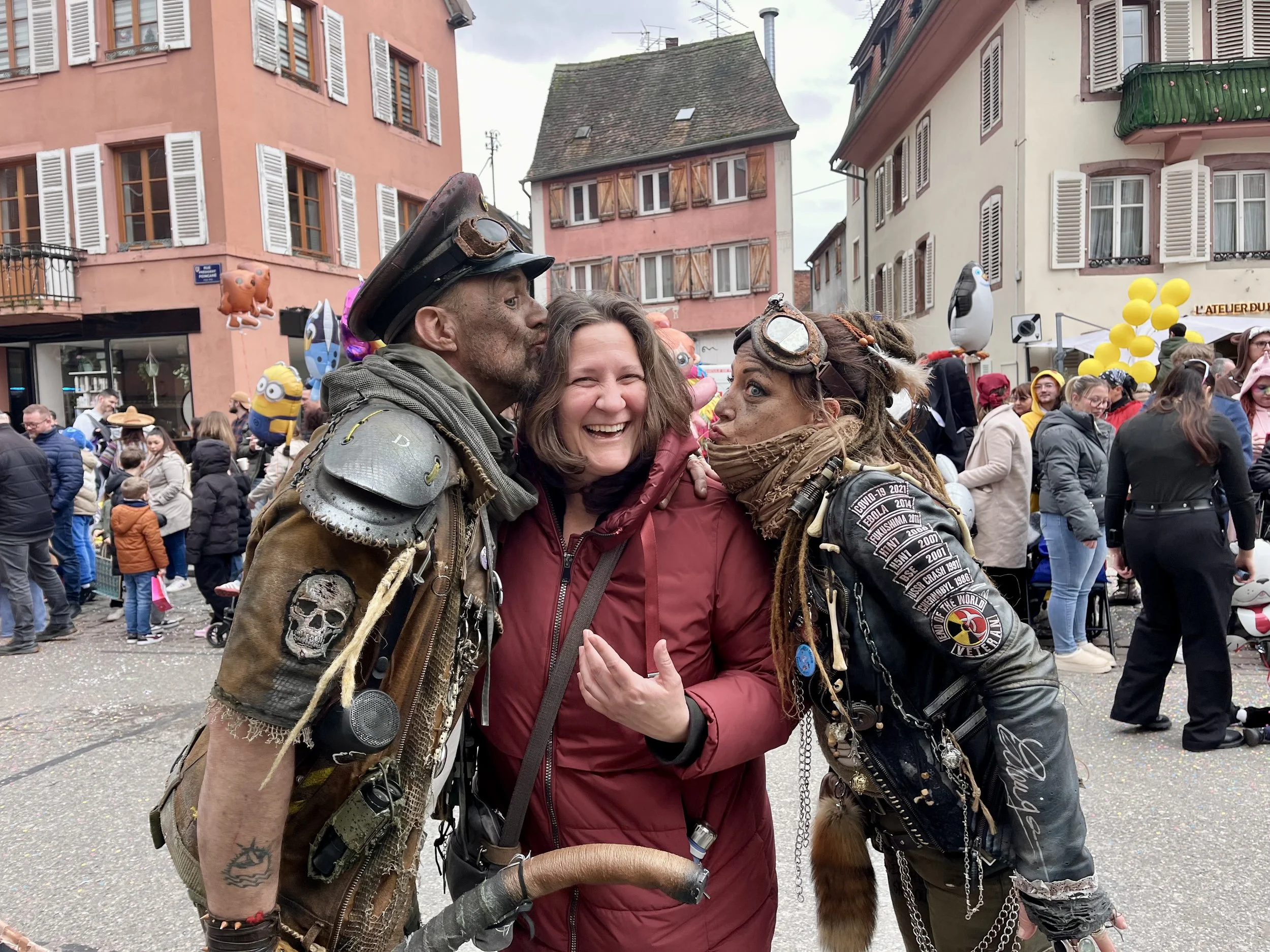
An unexpected moment at Carnaval in Selestat.
The Food
We can’t talk about life in France without talking about the food, of course!
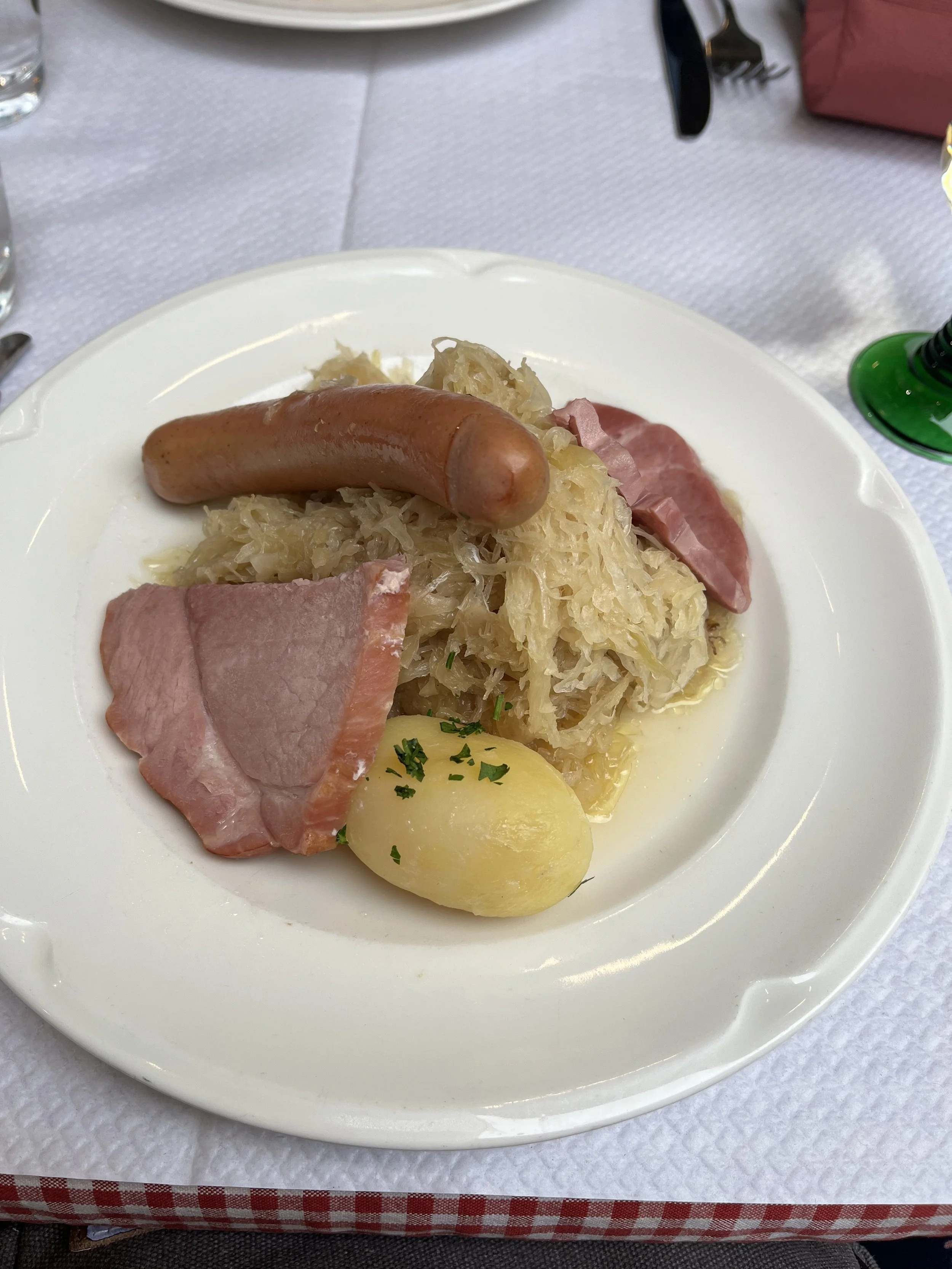
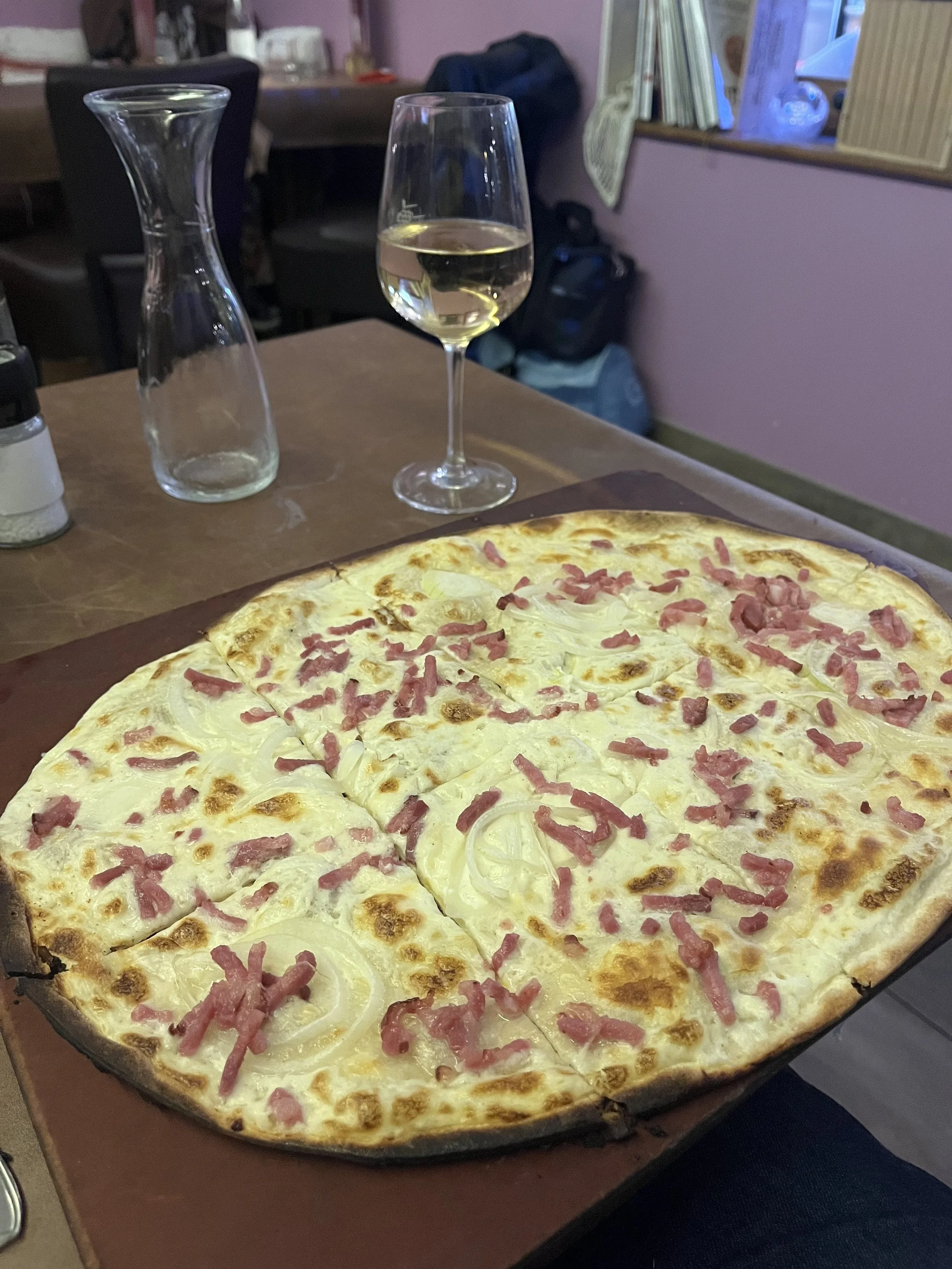
Alsatian cuisine is definitely unique, and with strong German influence. Some of the traditional Alsatian dishes include choucroute (sauerkraut served with a thick slice of ham, a sausage, and boiled potatoes — pictured below), tarte flambee (thin-crusted flatbread with creme fraiche, cheese, lardons, and onions — pictured below (although other variations exist, like one with apples topped with Calvados brandy that’s then lit on fire)), spaetzle (made with lots of cheese and with Alsace’s specialty pasta that contains seven fresh eggs per kilo), baeckeoffe (a stew made with multiple meats, vegetables, and white wine), kougelhopf (a bundt-style cake that is made more like brioche than actual cake), and bretzels (pretzels, the big soft kind that are delicious with cheese or mustard).
Pork, cheese, potatoes, and bread are featured heavily in this region, as are aromatic white wines (which go great with the cheese).
Things are less expensive…sort of.
Overall, my grocery bill has decreased compared to living in the U.S. (as has Hadyn’s food bill), indicating that yes, groceries are less expensive here — depending on what you buy. Produce, yes. Wine, mostly yes. Cheese, sometimes (not if you’re buying it from the expensive fromagerie in town that draws you in with free samples, and then the next thing you know, you’ve spent 80 euros on cheese). Meat…not really. I miss being able to buy packs of bone-in chicken breasts for like $6 when they were on sale. There is a much wider variety of meats and fish here, however. I’m just not that adventurous when it comes to buying, cooking, and eating them.
Clothes and shoes are similar, but also, I don’t shop much (unless we’re talking notebooks and journals, in which case prices for brands and styles like Moleskine are still as expensive as they are in the U.S.). And the area I live in is pricier for these things compared to surrounding towns, so many people shop either in Strasbourg or even in Germany.
One of the cool things about shopping, eating out, and buying anything is that the price is just the price. You don’t get additional sales tax added at the register; the price you see on the item includes the tax already. And when eating out (which is comparable in price to the U.S., I think?), the price includes service already. You don’t tip an extra 10-20% on top of the bill. You just…pay the bill. That’s it. You can leave an extra euro or two if the service was exceptional.
Farmer’s markets are amazing.
Seasonal produce from local farms. Giant pans of paella. Fried-while-you-wait potato galettes. Honey. Cured meats. Raw meats. So many cheeses. And those roasted rotisserie chickens — delicious!
Things truly are seasonal here, so you won’t find strawberries or asparagus year-round (what I wouldn’t give for strawberries and asparagus right now!!). Sometimes out-of-season produce from Italy, Spain, and Northern Africa can be found at the markets, such as oranges, dates, avocados, and mangoes. Things that seem to be in season no matter what time of year: lettuce, leeks, broccoli.
Also, did you know that France grows kiwis??? The fruit, not the bird. I didn’t either.
Food is higher quality here, but I do miss some foods from the U.S.
A few of the things I’ve found to be of higher quality in France: bread, cheeses, leeks, butternut squash (OMG it’s amazing), chicken, and eggs (phenomenal). The pasta from Alsace. Pastries. Chocolate. Lots of things, really, because so much of it is fresh, or has to follow stricter regulations (with less additives allowed).
Things that I miss from the U.S.: good bacon (for all their love of pork, France just doesn’t do a good thick-sliced bacon like in the U.S.), a big juicy burger, barbecued tri-tip, dark roast coffee, chicken broth that doesn’t come from a bouillon cube, spicy Thai food, and carnitas burritos and tacos.
Also, sometimes I really miss DoorDash. That’s not a thing in my town (although larger cities have Uber Eats and Deliveroo ). Takeout options are limited in a smaller town, and there isn’t much in the way of fast food (there is a MacDo (McDonalds) on the other side of town). Not that I was a big fast food person anyway in the U.S., but sometimes I would like to pick up something quick to take home for lunch or dinner after a long day. My new go-to is doner kebab.
There are a couple decent places here that do kebab, but the best place to get a wicked doner kebab is in Strasbourg. Kebs Baba Krutenau is my fav, particularly their spicy Kebs Kipik.
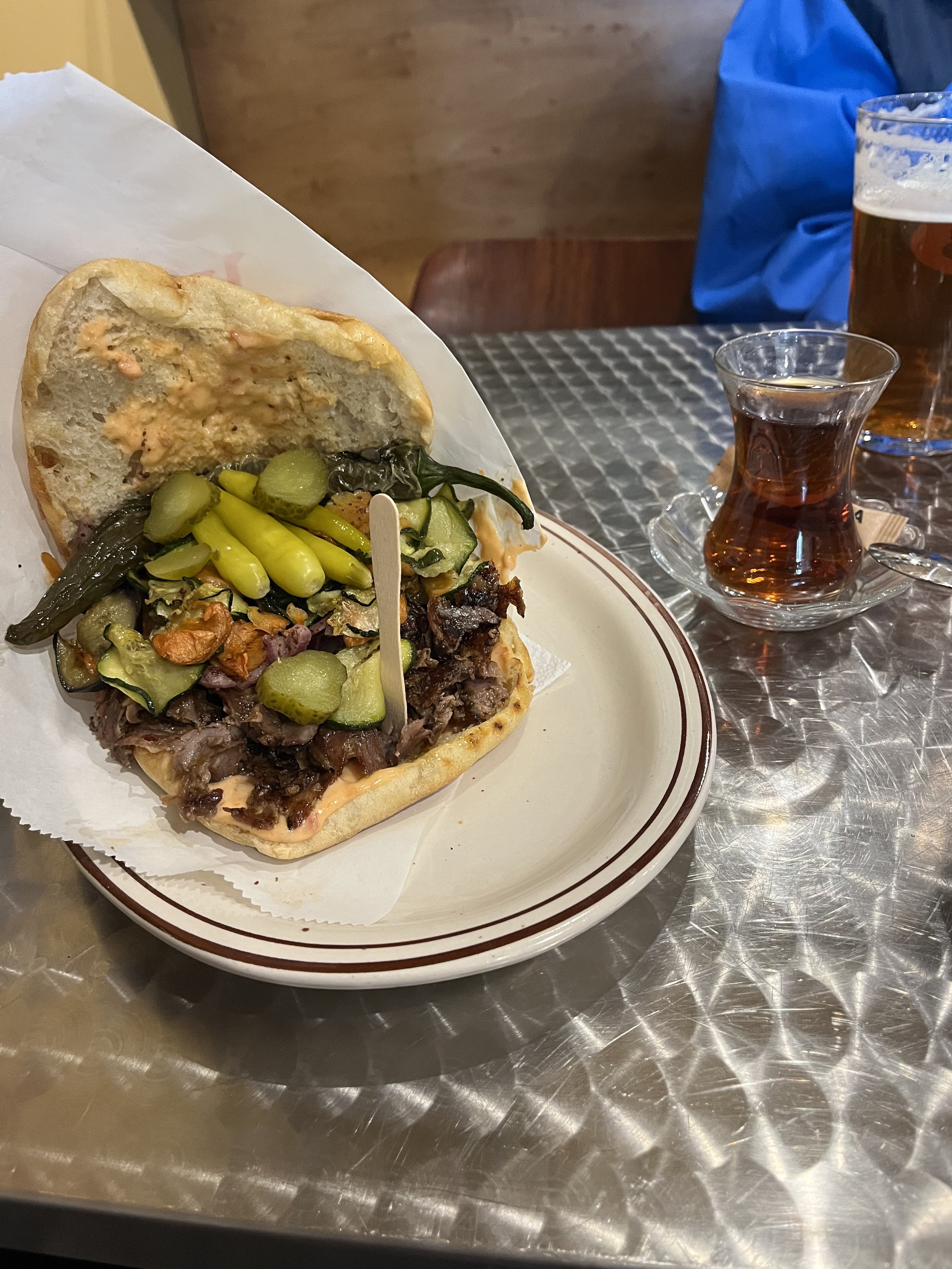
The Kebs Kipik from Kebs Baba Krutenau.
Wine just exists here as part of daily life.
Surprisingly, I actually drink less wine than I thought I would, even though my work is with wine and involves regular wine tastings.
But wine is just…normal. It’s a part of a meal or enjoyed as an apero with friends. It’s very social, and the accord (agreement) between the wine and the food is of the utmost importance. And of course, people here are very proud of their local wines, and celebrate them regularly. In fact, there are over 100 different wine festivals in Alsace from April to October!
Since being here, I’ve developed my taste and appreciation for white wines, which are the main wines found in Alsace (along with Pinot Noir). I especially love the sparkling wine, the Cremant d’Alsace. When I miss bold red wines, I head down to my local caviste and buy something from the south of France or the Rhone valley. This expedition usually involves tasting different selections, conversing in French (he is very patient and helpful with my French), and reviewing the giant map of the region and appellation pertaining to the selected wine.
I’m learning that you don’t just buy something (anything) here; you also develop connections and relationship in the process.
The Transportation
Cities are highly walkable, and towns are, too…to a point.
Yes, I walk everywhere, and it’s marvelous. Except when it’s pouring down rain and I need to walk 30 minutes to get food for the dog. Then it’s less marvelous.
Generally, I can walk everywhere I need to within town: grocery store, supermarket, veterinarian, boulangerie, pharmacy, farmer’s market, wine shop, train station, park, vineyards, garden center, home goods store, coffee shop, French class. I can even walk between towns if I want, along voies vertes (greenways) and bike paths (although that takes a while).
However, there are places that aren’t easy to walk to, and even if I did, it would require walking down a busy two-lane road with no sidewalk, no shoulder, and good likelihood of being hit by a car or delivery truck (delivery drivers turn driving on narrow medieval streets into a competitive and highly dangerous sport). And of course, if you are making big purchases of groceries, home goods, cleaning supplies, dog food, etc., you have to lug all that back with you somehow —usually via public transportation.
Public transport is great…but also sometimes not.
It’s been great not having the expenses and required upkeep of a car. The Pass’O bus here in town is free, and until they changed their lines recently, it took me everywhere I wanted to go. It’s easy to hop on and hop off, with lots of stops around town that are easy to access. However, with the new routes and the increased traffic on the bus, it requires a little more planning and effort — and an avoidance of those busy morning and afternoon school hours.
I still find myself walking to most places because it’s about the same amount of time or even sometimes faster. Or because it’s better than being packed into a shuttle bus with standing room only.
You know the crowding is bad when all the teenagers waiting at the bus stop let out a collective groan of “Mais non!” as they see the Pass’O bus approaching, crammed full of elementary school children like sardines in a can (chockablock, as my French-Australian friend would say).
While I can use the bus to get around town and even between towns (as well as using the train for SOME towns), there are times where I need to go just one town over, and my choices are either an hour+ trip by public transportation or a 10 minute car ride. For things like that, public transport just isn’t helpful or useful. Additionally, some towns here aren’t accessible by any public transportation at all, particularly some of the wine villages I need to reach for my job.
Even in Strasbourg, where there is a solid tram or bus system in operation, it’s not like it takes just a few minutes to get where you need to go. Okay, SOMETIMES it does. But often, I have to schedule an extra hour/hour-and-a-half to take the train to Strasbourg, get from the train to the tram, catch the right tram, take it 25 minutes across Strasbourg, where I then need to walk an additional 10-15 minutes to get to my destination. And this doesn’t take into account the times the tram is packed so full that there is no room to get on.
For example: just recently, I was almost left behind on a tram platform in Strasbourg while my parents crammed into the mass of humanity packed into the VERY FULL tram. I was the one with the tickets, and we needed to all be on that tram together so we could make the train home. Thankfully, my dad’s backpack got caught in the door, which allowed me to force my way in after the doors had already closed for the final time!
Despite that, we missed the train because the tram was late, and therefore had to wait another hour before the next train. Fun times.
Public transportation can be be great and convenient, but also frustrating and inconvenient. One thing it does is force me to slow down. There really isn’t any “rushing” anywhere (unless it’s sprinting to make your train because the tram to the station was late). When I feel annoyed or sense that “rushed” feeling, I take a beat and remind myself that one of the reasons I moved here was to have a slower pace of life.
It also makes me better at planning ahead (as I book a TER train from the platform two minutes before it arrives).
Where I live, not having a car limits you.
This is one point where I take umbrage with the “live abroad influencers” out there that make not having a car a selling point for making the move. It is more nuanced than this.
If you are living in a big city where public transportation is excellent and you are well-connected to other cities, then not having a car isn’t an issue. But as soon as you move outside of the cities and into a smaller town like my new hometown — where there is a train station and a train line, but many of the surrounding towns aren’t on it — then not having a car makes your world a whole lot smaller, especially if you need to travel for work.
Granted, there are plenty of places I can go with just a train or bus (which I use only if I have to, because buses aren’t my fav), or even with a rideshare like Bolt, or a taxi. The other way around this is to make friends with people who have cars, and then you get to tag along when they drive places. Or you rent a car — but you’ve only got one year to do that on your current driver’s license until you get a French license (which, if you don’t come from one of the 18 U.S. states that has a driver’s license exchange with France, means you have a long, arduous, and expensive road ahead of you to get your French license).
Additionally, not having a car to take your dog to the vet in an emergency is stressful. Thank goodness for friends with cars!
Sure, the dog can go on some public transportation, but it’s complicated.
I’ve had people tell me so casually “Oh, you can take your dog on public transportation, so not having a car isn’t a problem.”
Yeah, no. It’s more complicated than that.
This deserves an entire blog of its own (look for one soon!) about traveling by train with a big dog. Suffice it to say that France is dog-friendly but geared toward small dogs rather than big ones, and that while you CAN travel by train, it requires preparation, planning, high-level dog handling skills, and a dog with excellent environmental nerve strength.
Train travel can be loud, crowded, and an exercise in emotional regulation. While on the platform, there are whistles from conductors, screeching train wheels, alarms screaming as the train doors close. In the station, there’s masses of people milling around and wheeling all sorts of luggage. There’s people with bikes, scooters, children, and strollers. There’s slick and reflective surfaces, stairs, escalators, glass-walled elevator lifts, and metal grates that must all be navigated along the way. There’s tight spaces with people smashed right next to your dog, even if they are a dog in need of personal space.
A dog needs to be environmentally sound to handle all of that well.
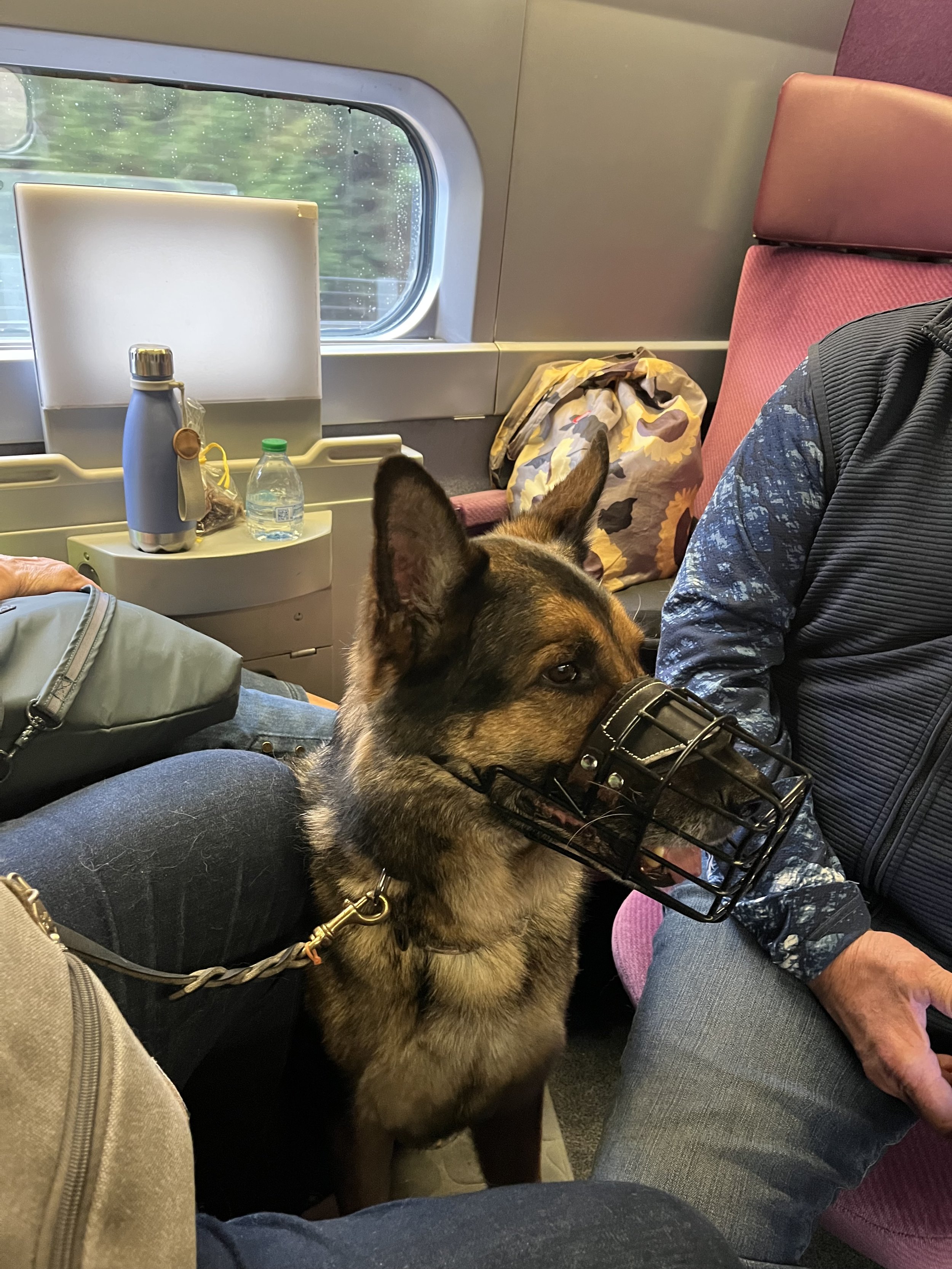
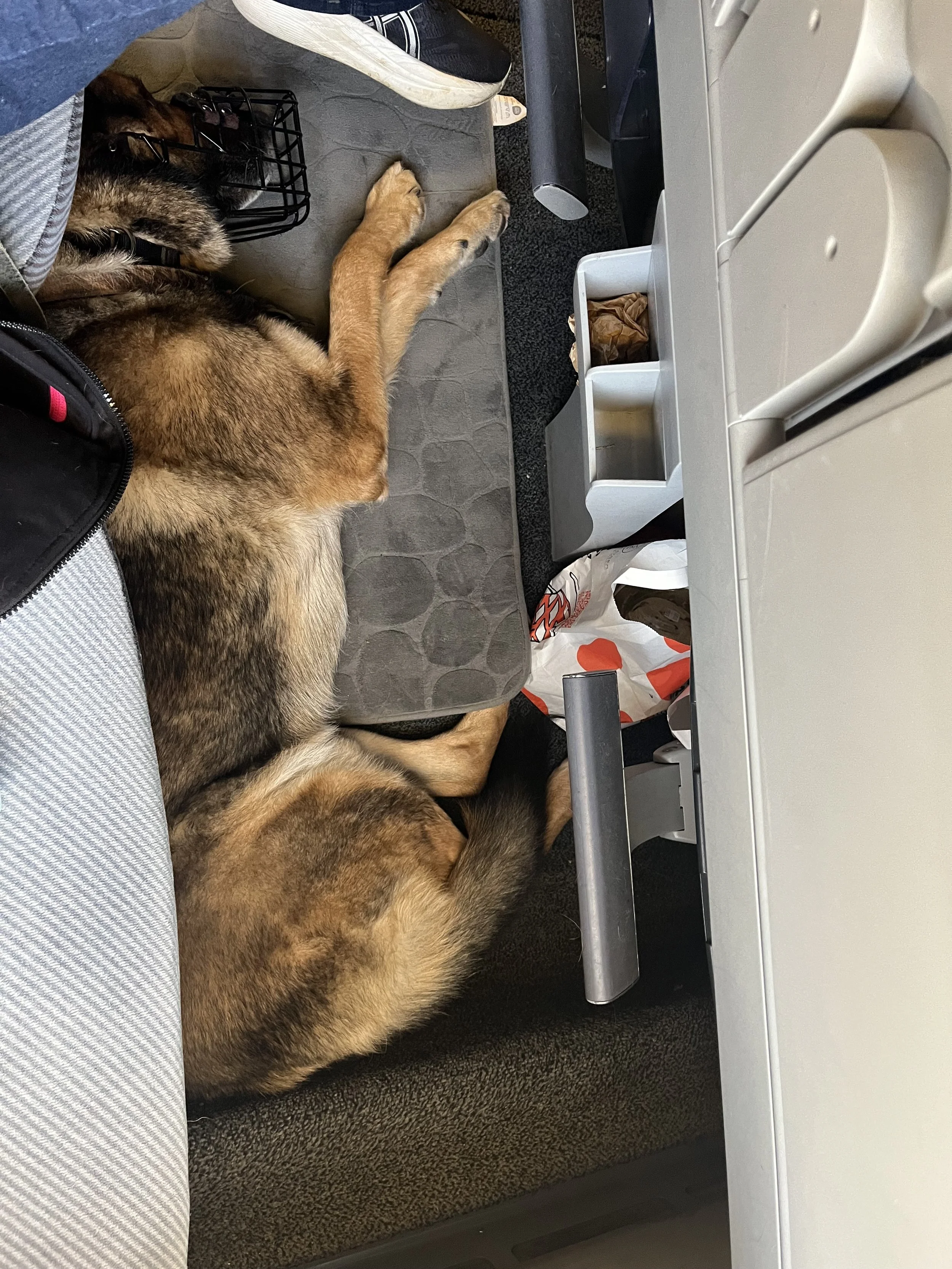
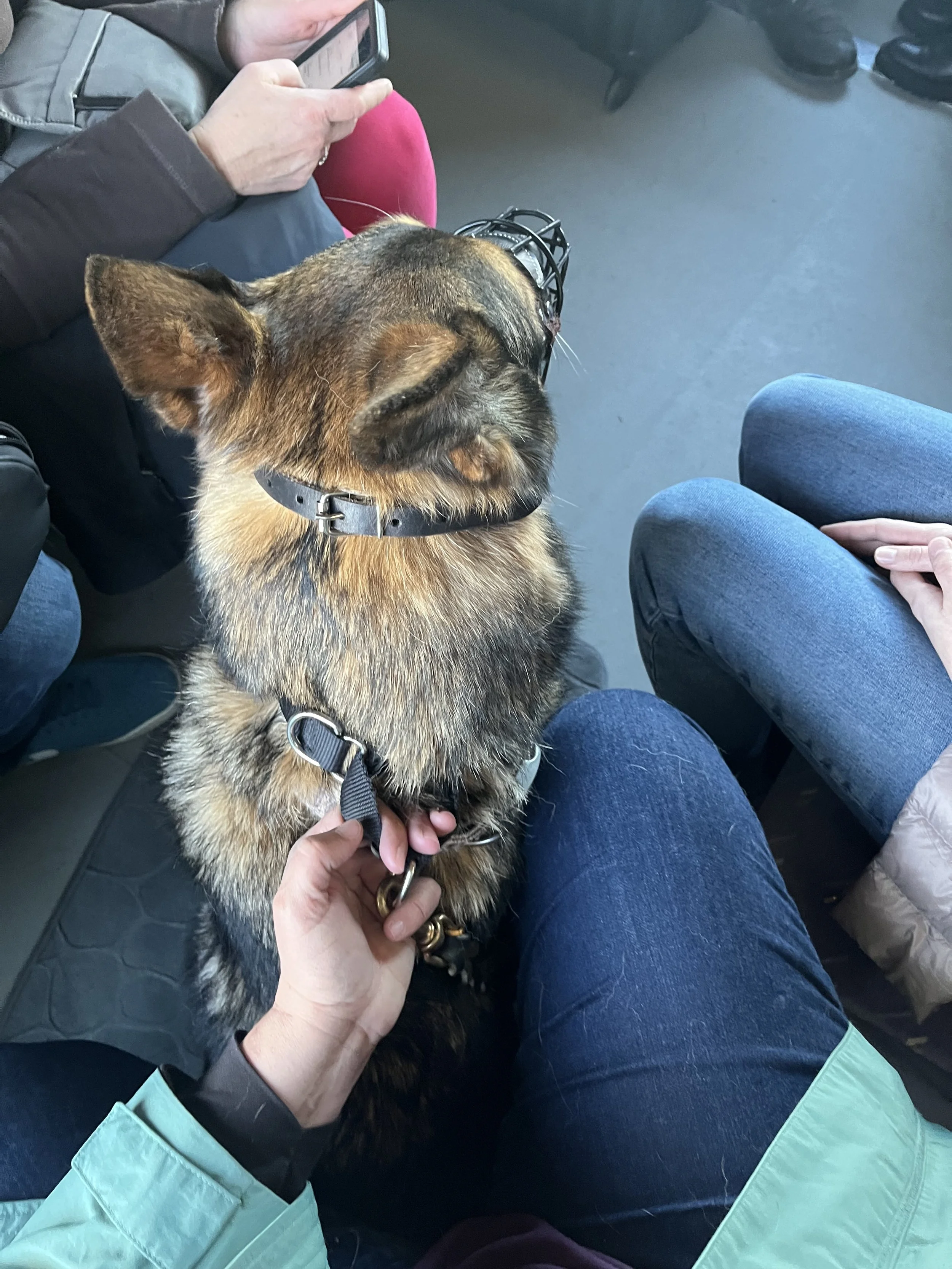
Hadyn on the train. From left to right: TGV train with my family, TGV train by ourselves, and on a very crowded and hot TER train surrounded by strangers.
Hadyn can accompany me on regional TER trains and high-speed TGV trains as long as he is leashed and muzzled (and you have to buy a pet ticket). He can also go on trams in Strasbourg if leashed and muzzled. Although, having ridden those trams by myself and seeing how packed they are with people (standing room only), I wouldn’t recommend taking a dog on them (unless you take a less-used line or travel at a ‘dead’ time, if such a time exists for popular lines).
While buses may allow small dogs in carriers, they don’t allow big dogs on board, period. This means Hadyn and I have to walk wherever we want to go in town, including to the vet. I’ve contemplated getting a bike with a little sidecar or wagon, and training him to ride in it with me. I think it would be fine… until he sees a squirrel.
La Vie Quotidienne
Daily life in my corner of France has a slower, calmer pace to it. It took several months to develop a new routine and settle into a new rhythm. Some of the adjustments that stand out the most:
There’s visual quiet.
There aren’t ads screaming at you from everywhere. No TVs blaring or even on at all in businesses, bars (a few will have a TV), restaurants, waiting rooms. There are few billboards. Cars aren’t plastered with bumper stickers or flags. In fact, there are few flags, period. Just on government buildings and memorials.
People here do not make guns, “patriotism”, religion, or a particular political candidate their entire identity, and it is so refreshing. Like, cars are just cars, houses and yards are just houses and yards, churches are just buildings with beautiful architecture and deep history, and people have normal and varied interests that don’t dominate their personality.
This visual quiet creates a different vibe. It’s calmer, more relaxed. You feel lighter, freer, and safer. Less worry. You feel like you can breathe and just slow down. Because you aren’t being bombarded all the time by triggering or excessive stimulation, you slowly learn what it’s like to have a well-regulated nervous system.
It took me months to get my nervous system to calm down from the hypervigilant state it was in after living in the U.S. It’s hard to even explain until you experience what it’s like to not be in it all the time — like having a huge weight lifted off you that you didn’t even know you were carrying.
There’s visual beauty and interesting things to look at everywhere.
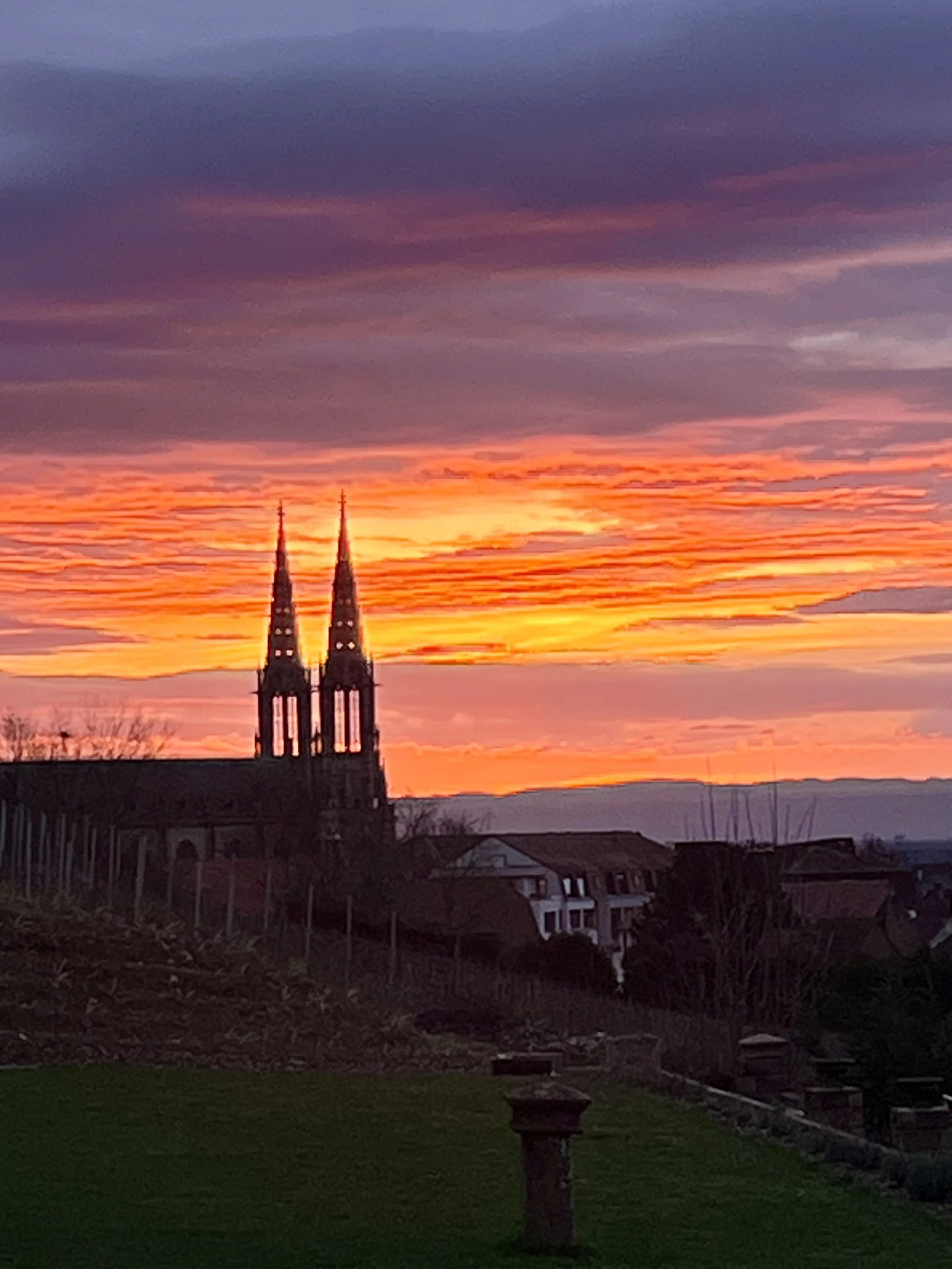
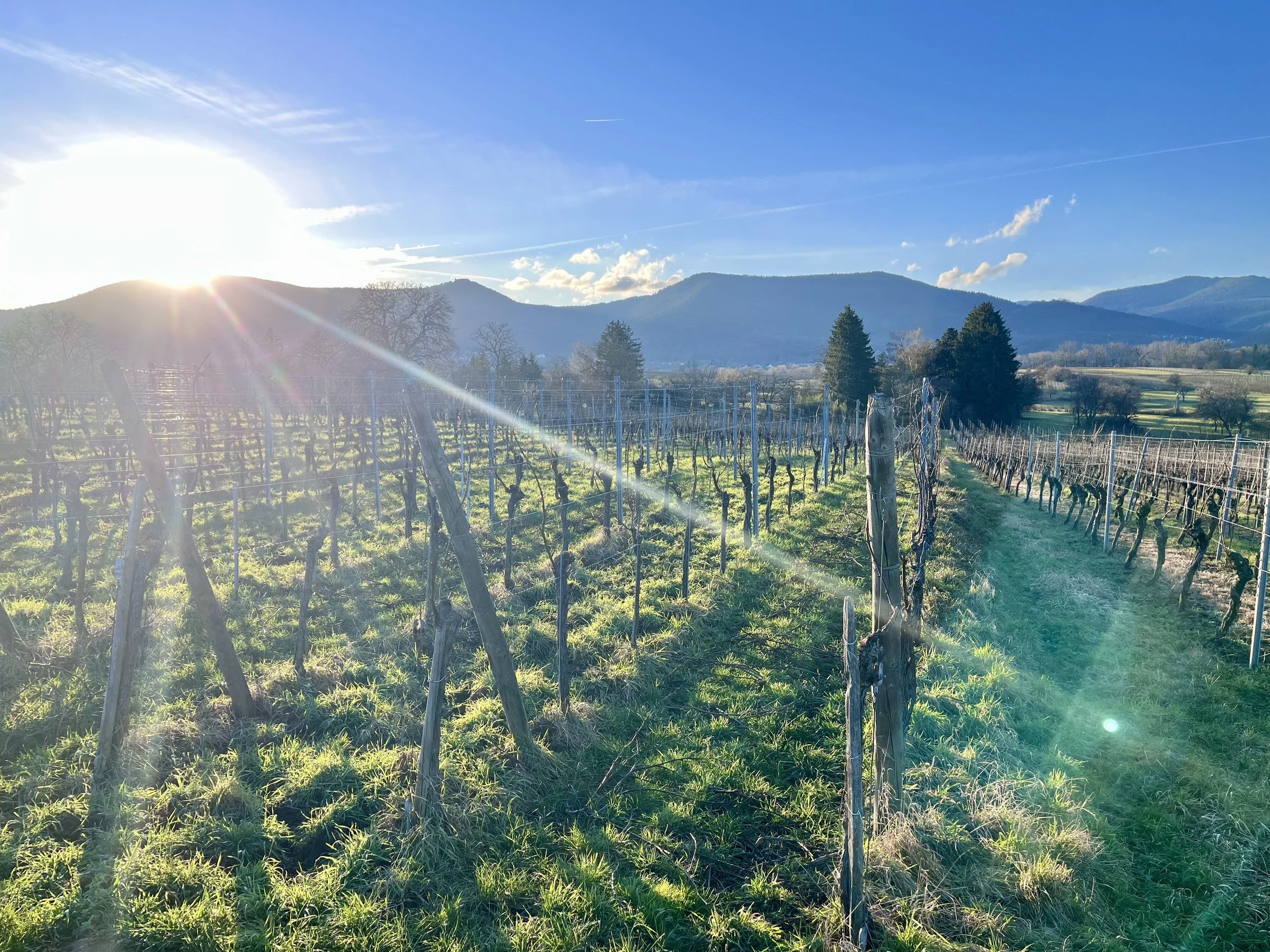
Stunning sunrises and sunsets. Rolling green hills covered in vineyards. Forested mountains dotted at regular intervals with remnants of medieval castles and lookout towers. The immense red sandstone Haut-Koenigsbourg castle towering high above the valley.
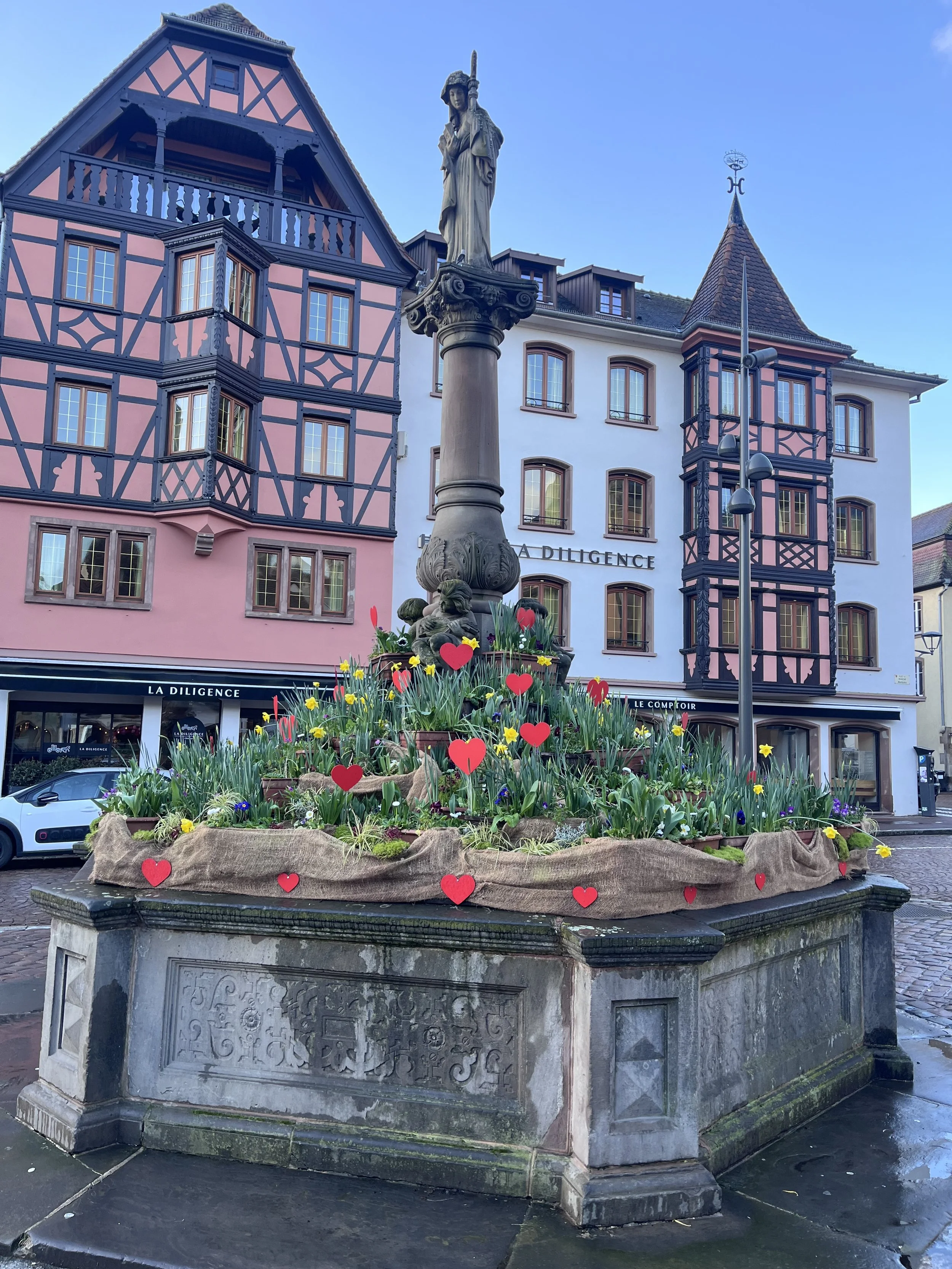
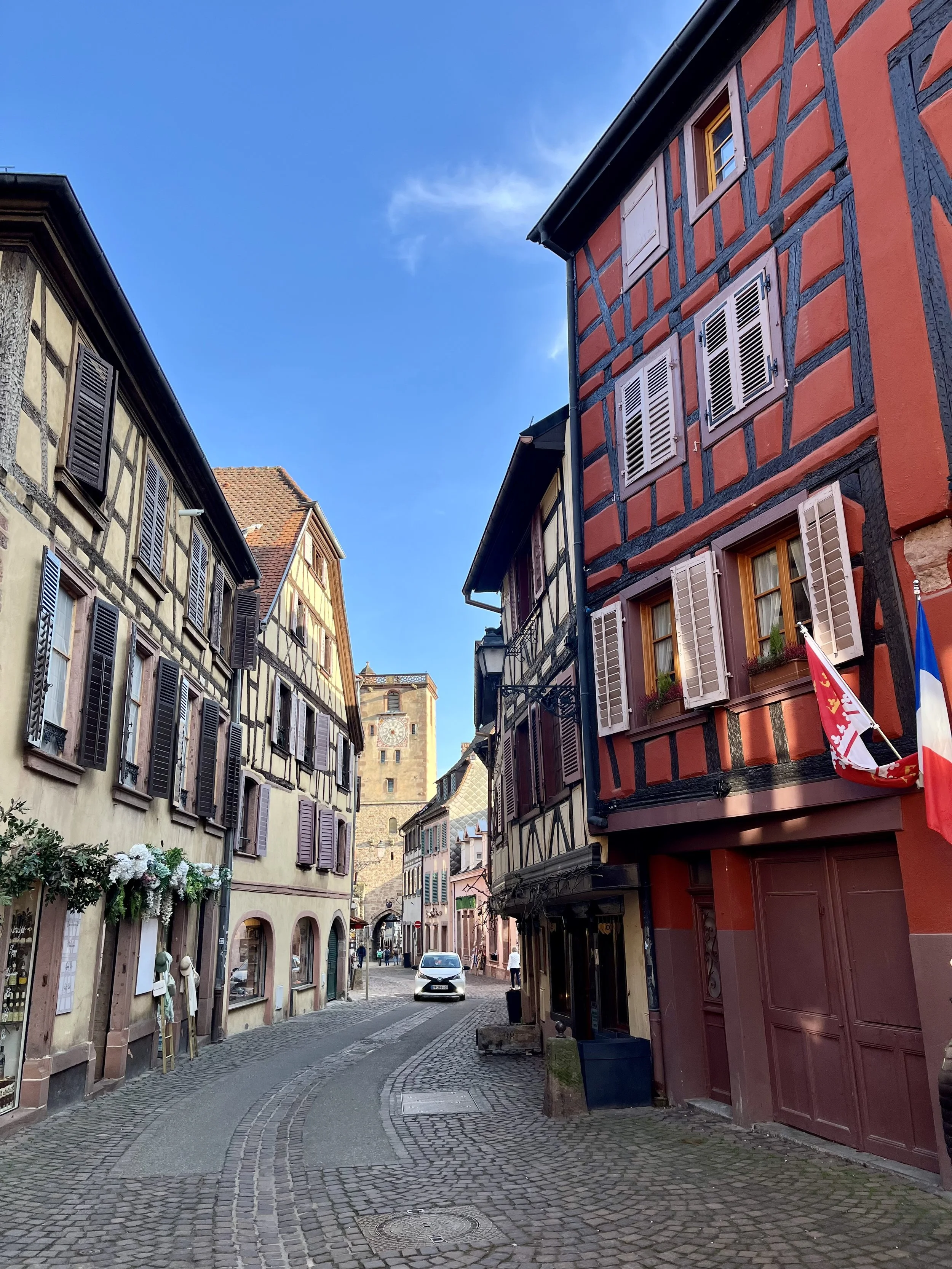
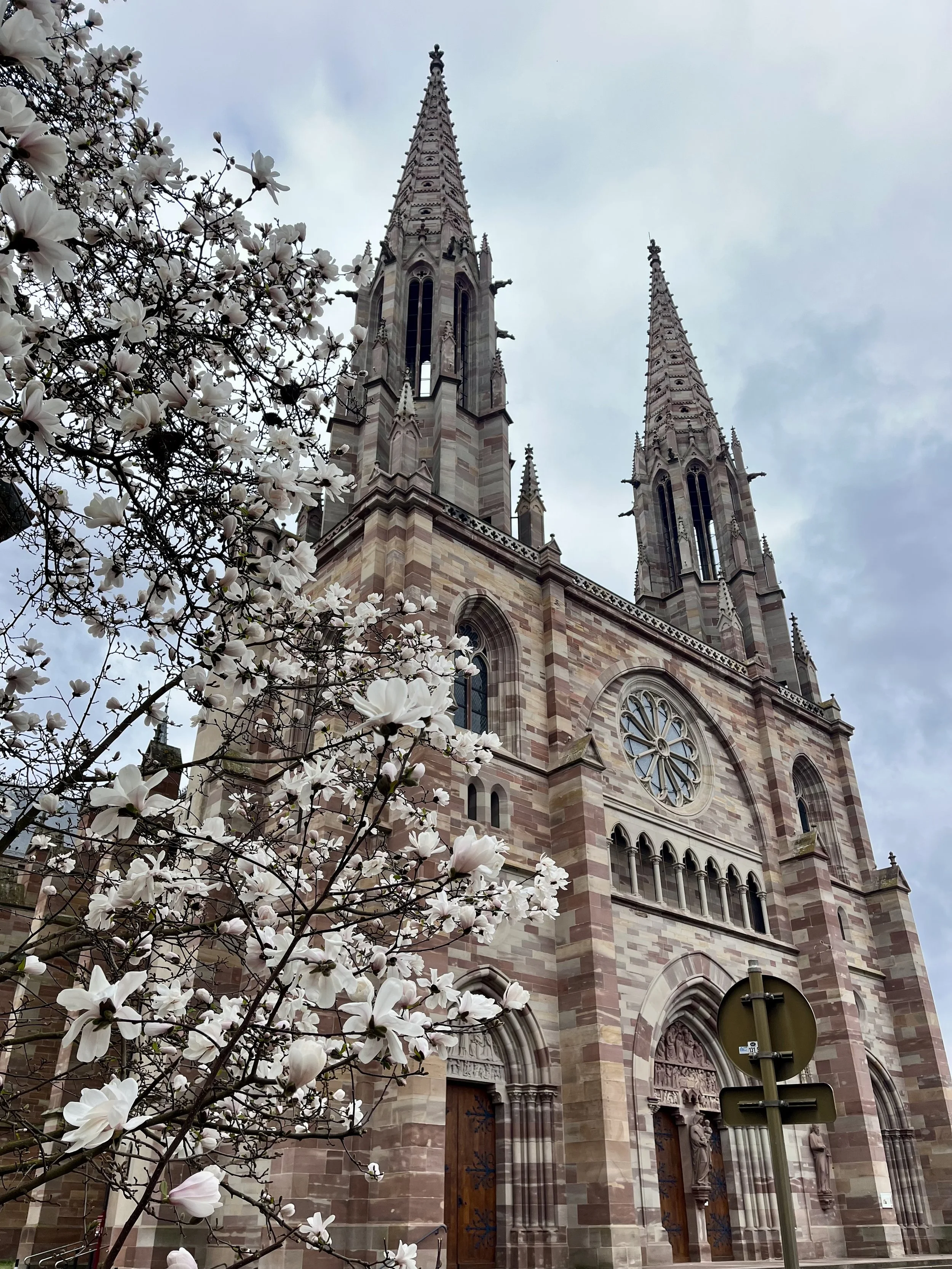
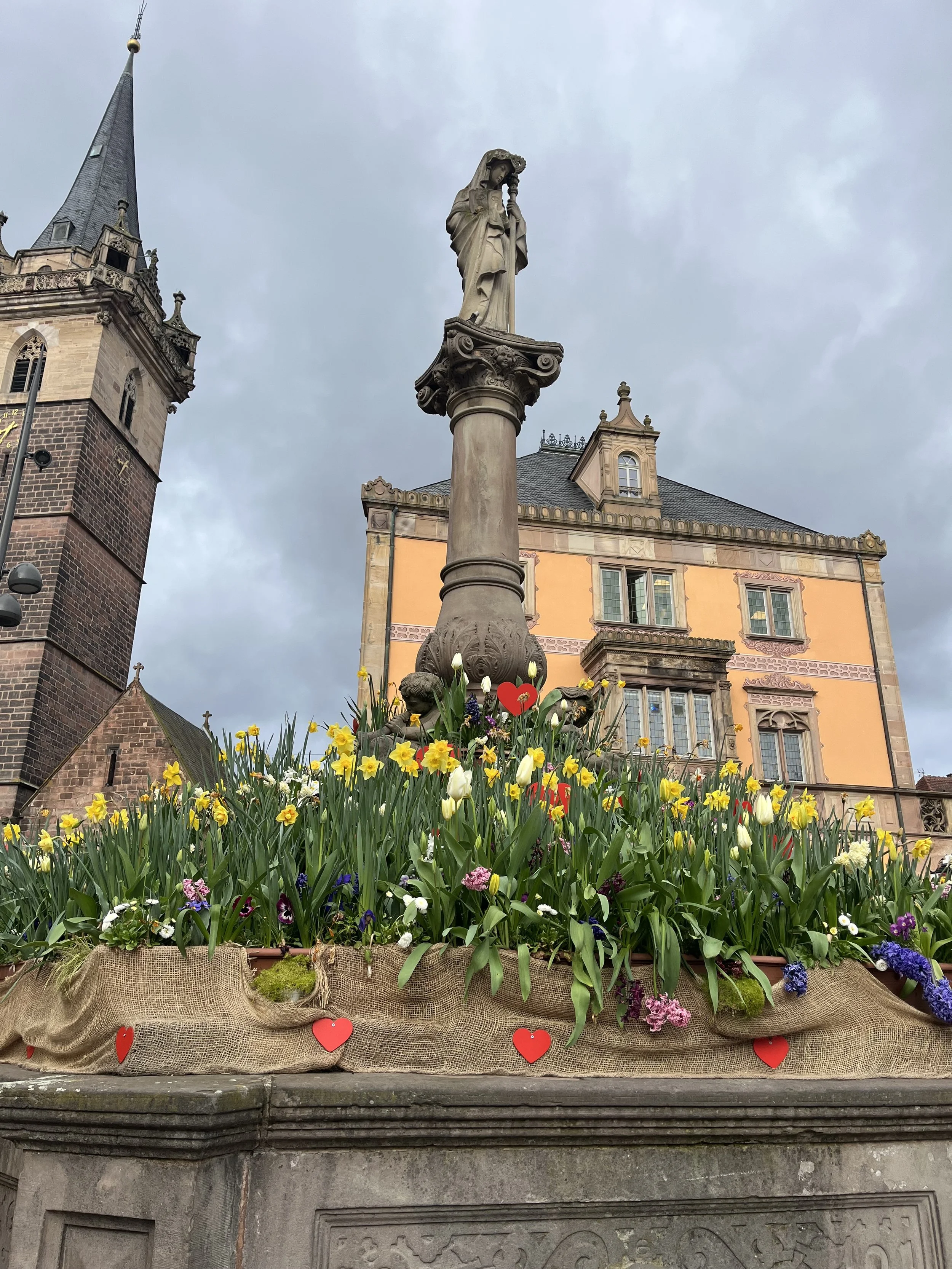
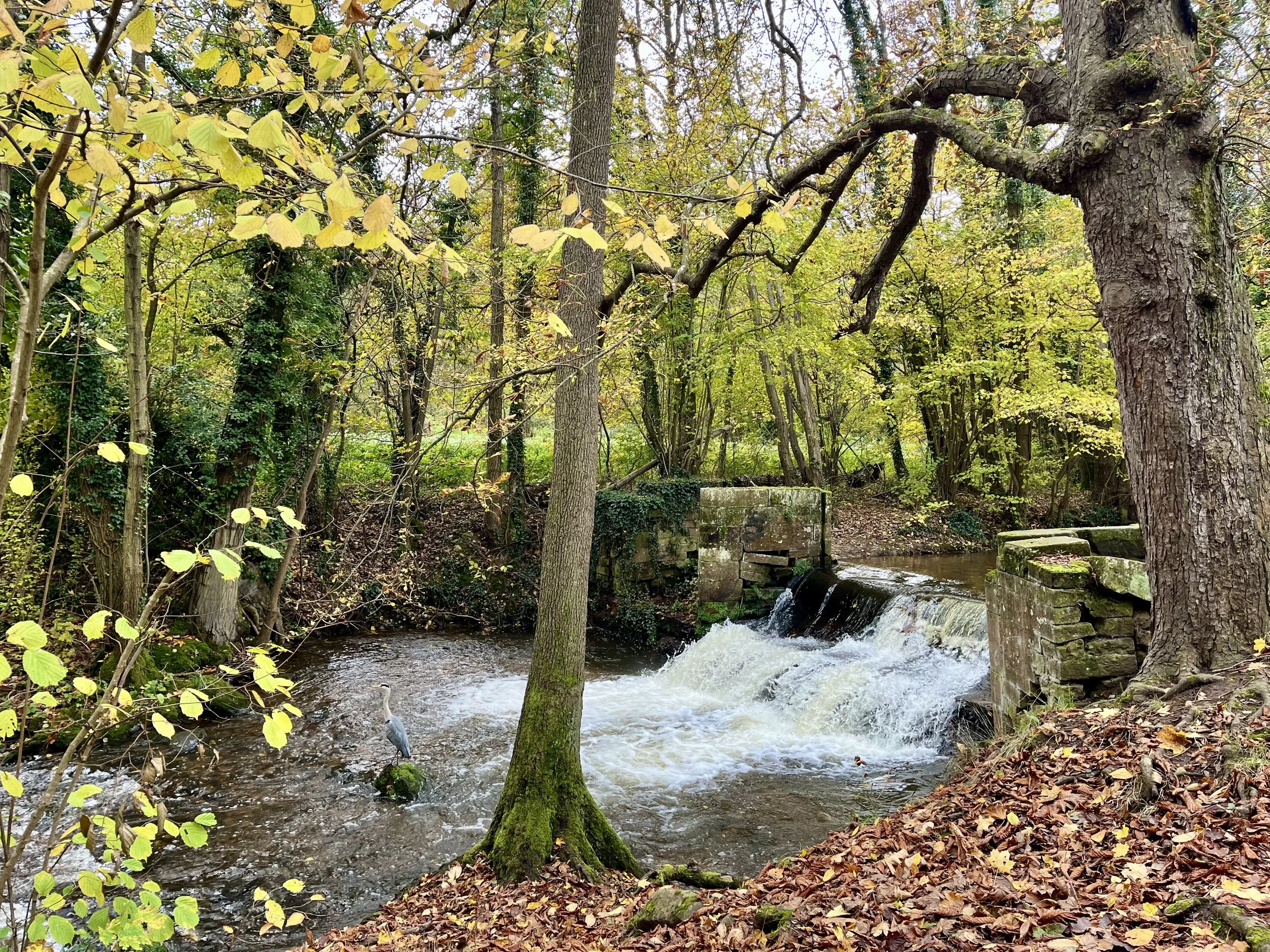
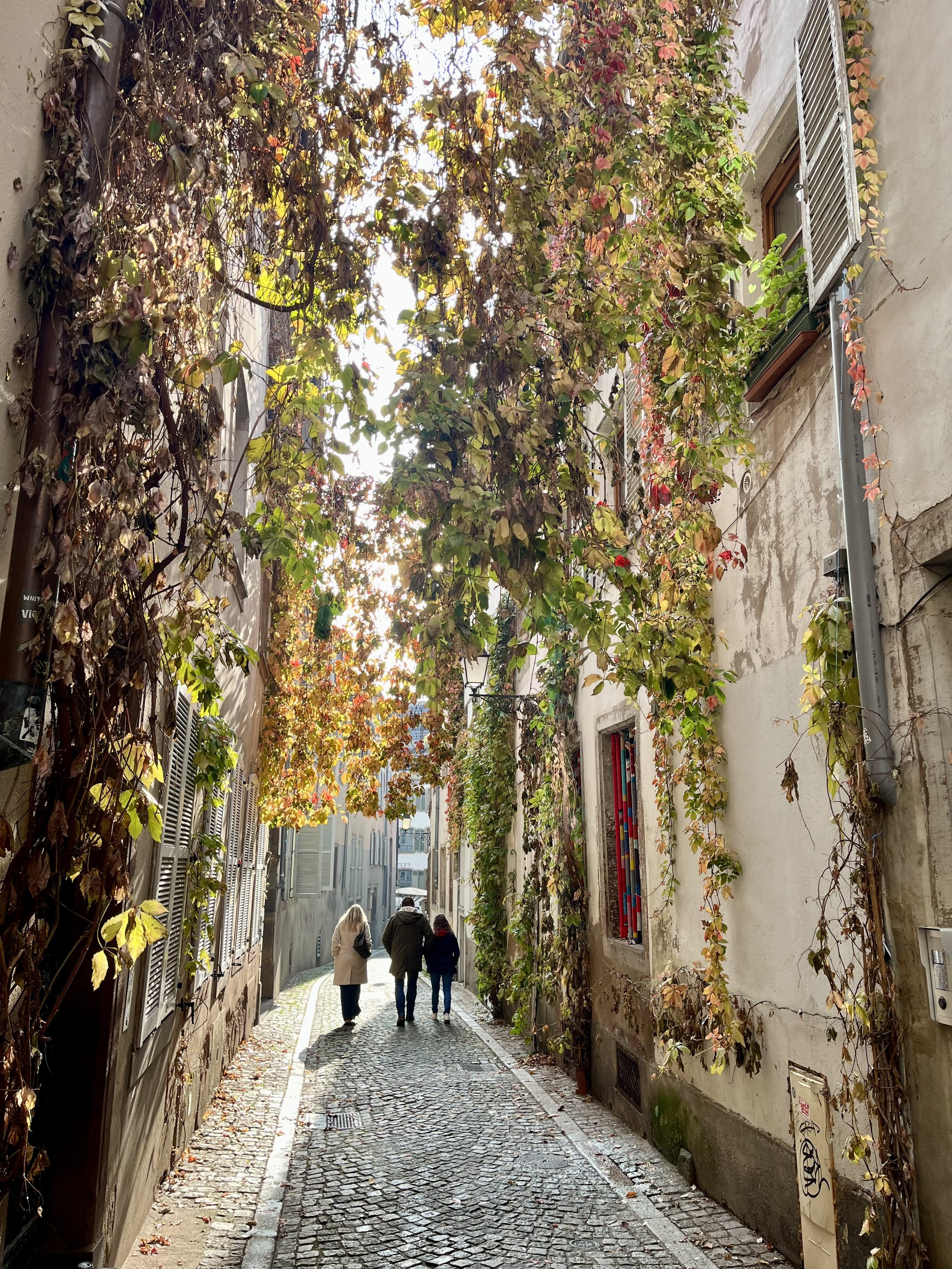
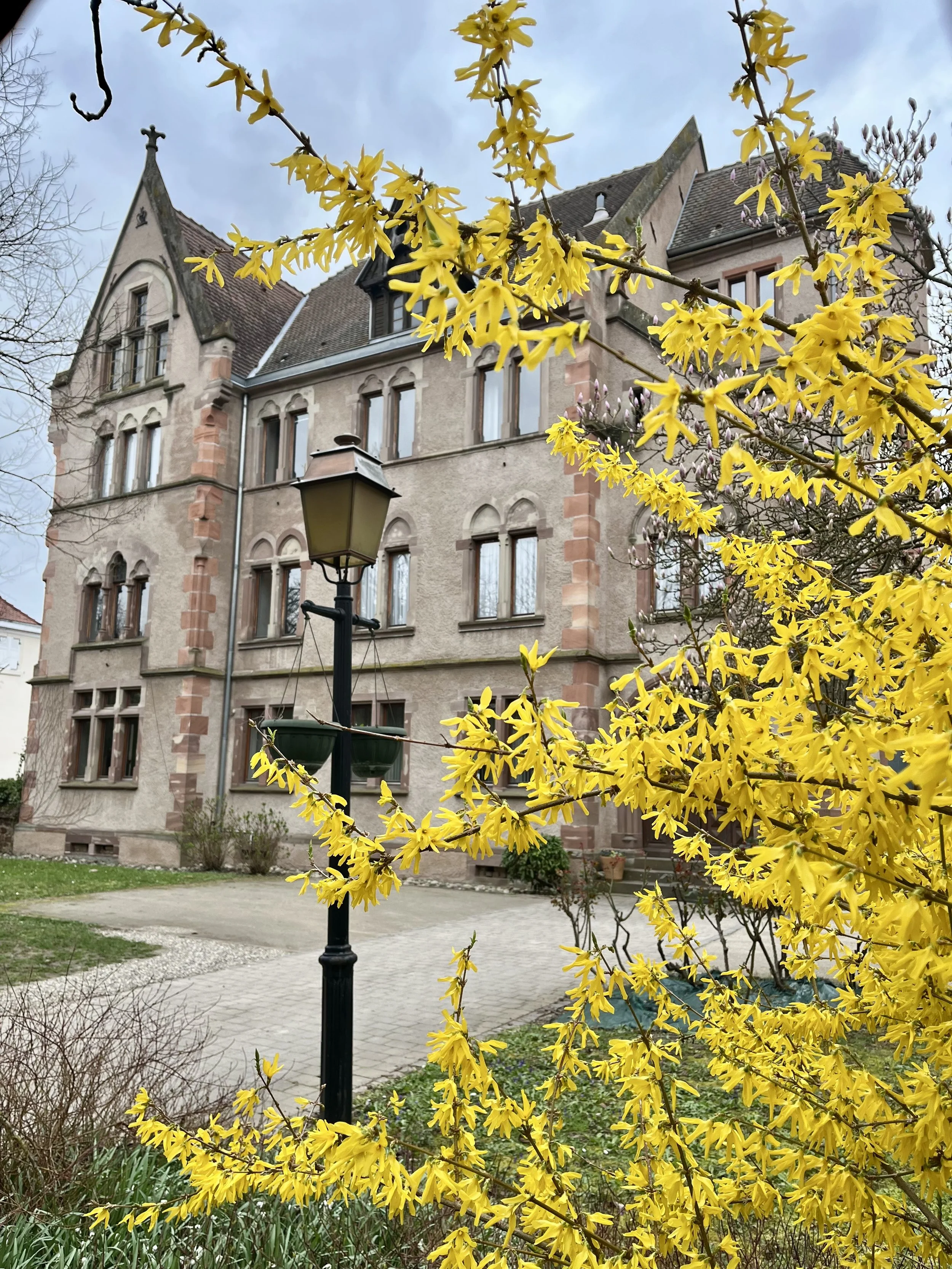
Here, wherever I walk I can gaze at the beauty of nature or at the stunning architecture. There’s always something interesting and aesthetically pleasing to look at: the French flag hanging from the town hall, waving gently in the breeze. The Gothic spires of the church, medieval bell tower, the cobblestone streets. The stone walls covered in moss and ivy, with a river babbling alongside. The planters full of a riot of tulips, hyacinths, irises, pansies, daffodils.
Yes, there are parts of town that aren’t as nice to look at, with industrial buildings or blocks of purely functional apartments. As towns grew and expanded, they often did so in a less aesthetic fashion.
But overall, things exist here for the purpose of being beautiful and not just functional, and that beauty is intended for all to enjoy.
Don’t forget your keys, because the door automatically locks behind you.
Seriously. You don’t have to turn around and lock your door as you leave, because as soon as it shuts — BAM, you’re locked out of the house. And if you don’t have your keys, well…guess who’s calling a locksmith?
Also, the locks either open right away or turn forever. The first time I had to use the key, I was worried that the lock had been stripped because the key just spun and spun, until FINALLY it caught and opened the door. But apparently, that’s just normal.
The locks took some getting used to, but between a few times of leaving the house without my keys (thankfully I have a keyless entry option as well) and of accidentally leaving my keys in the door (sometimes overnight — eek!), I’ve got it down now.
Deliveries are a stressful experience.
They don’t leave things at the door here. Instead, they call you to confirm the delivery address, and if you don’t pick up to confirm, you don’t get your package and you have to reschedule the delivery. Which means you better have enough French to talk with a representative over the phone.
For some deliveries, you can have them routed to an access point like a grocery store or a tabac. This is convenient, but it doesn’t work with all deliveries (such as Hadyn’s food delivery, which is a stressful and complicated experience of text messages indicating a delivery window, obsessively watching the delivery truck on the map to time when it will actually arrive, a confirmation call that sometimes happens and sometimes doesn’t, and running outside to flag the truck down so they don’t try to deliver to the wrong house—then rescheduling the delivery in my A2 level French for the next day after they do try to deliver to the wrong house…and another day of repeating the same process all over again …).
Also, forget shipping things to the U.S. With the wildly unpredictable and ridiculous tariff situation, sending packages from France to the U.S. was suspended. Gifts under 80 euros can be sent through Colissimo or Chronopost now, but it’s complicated and expensive. Hence the reason I still have my family’s Christmas gifts sitting here on my dining table.
What’s a screen?
Seriously, none of the windows have screens here. You just open them, and all the bugs come in. Not that there are as many bugs here, but there are strange little black and red beetle things (not ladybugs — those are cute, and these are NOT), mosquitoes, and the large spider that hid in my shower and politely waited until I was done before emerging and making itself known (cue screaming and throwing of shampoo bottles).
But if you want fresh air inside, you basically leave an open door (or window) for whatever’s outside to saunter in (unless you go buy and install your own screens, of course). C’est normal.
Two hour lunches are a thing.
Businesses close for two hours at lunchtime and reopen 2 or 2:30 pm. It’s both amazing and frustrating.
Coming from the world of teaching, where I theoretically had a 30-minute duty-free lunch that ended up being a 15-minute scarf-fest and potty break, a two-hour lunch is fantastic. Even kids go home from school to have lunch. And that lunchtime is taken seriously. Businesses lock their doors and shutter their windows, and everyone just disappears.
Restaurants that serve both lunch and dinner often block out 12-2 pm for their lunch service, then close until dinner time. Which means this two-hour lunch can also be a frustrating endeavor if you’re out and realize you need to eat lunch, but it’s already 1:45 pm and restaurants aren’t seating anyone else since lunch closes in 15 minutes.
In times like this, best to opt for a doner kebab.
Overall, however, I’ve learned to settle in to this routine. I take that two-hour lunch (sometimes at home, sometimes not), walk my dog for a bit, and then get back to work feeling refreshed.
At some point, people recognize that you live here and aren’t just a tourist.
Tourists are common in this area, and while people are quick to recognize me (especially with the dog), they assume I’m just a tourist passing through. But once that two- or three-month mark hits, they realize that I am indeed here to stay, and I become part of the background life of the town.
After six months here, people wave to me from across the park as they walk their dogs, chat with me in the grocery store or at the checkout, and ask me if I want “the usual” when I come in for takeout, coffee, or rotisserie chicken (avec pommes de terre, of course).
That little shift is significant, because it means I’m starting to integrate into la vie quotidienne, or daily life. That little shift makes this beautiful place feel like my home.
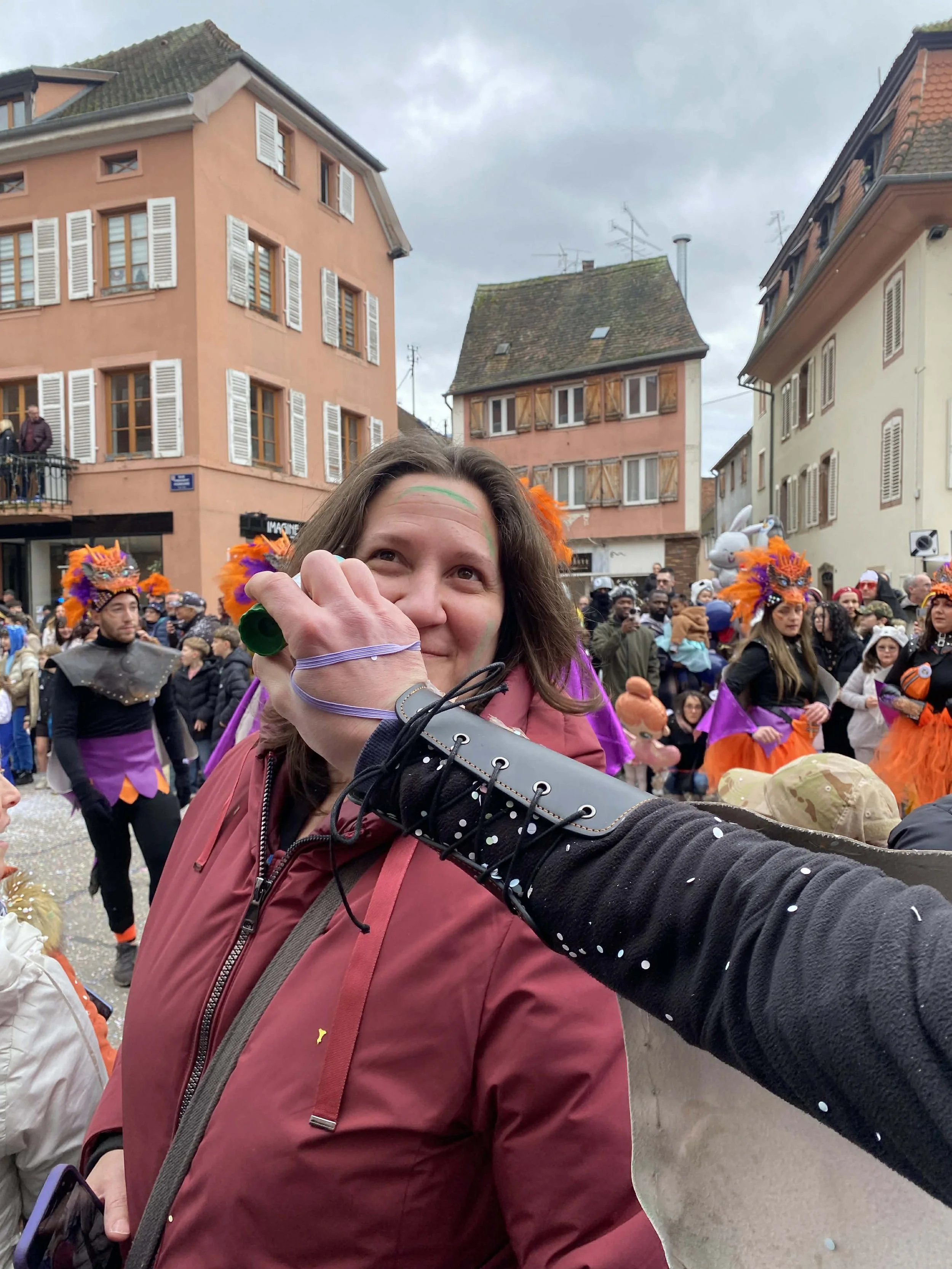
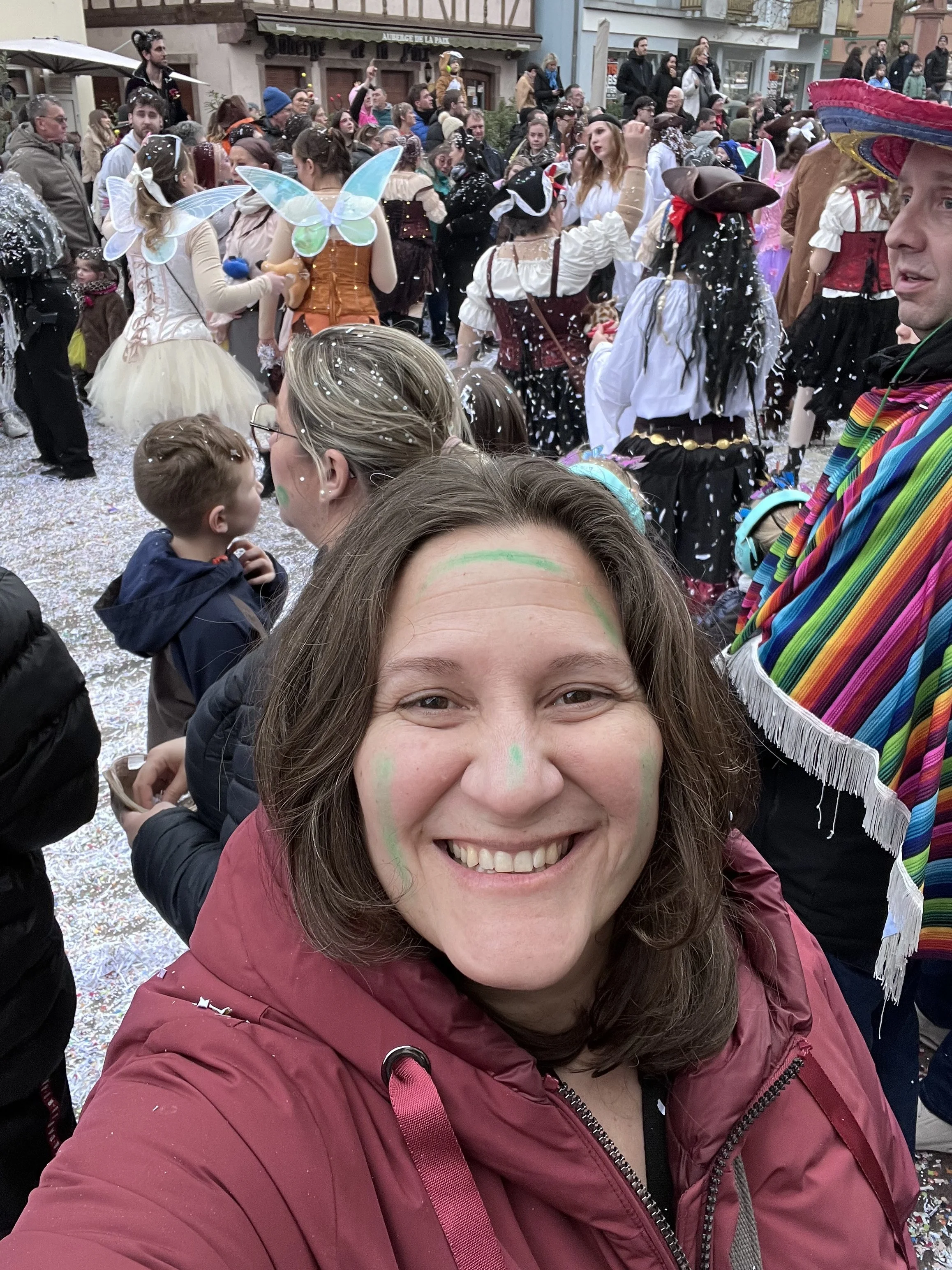
Getting in the spirit of community with Carnaval!!
